Sunday, April 1, 2012
Thursday, March 29, 2012
Coral Reef Destruction
Computer Research
Answer the following questions on page 133 of your science notebook.
1. What are coral reefs?
Website 1
Website 2
2. Why are coral reefs important?
Website 1
Website 2
3. What are zooxanthellae?
Website 1
Website 2
4. Describe these 4 ways in which coral reefs can be harmed:
Answer the following questions on page 133 of your science notebook.
1. What are coral reefs?
Website 1
Website 2
2. Why are coral reefs important?
Website 1
Website 2
3. What are zooxanthellae?
Website 1
Website 2
4. Describe these 4 ways in which coral reefs can be harmed:

Tuesday, February 28, 2012
Spectrascopes
Open your science notebook to PAGE 109.
Write the following QUESTIONS & ANSWERS in your notebook.
1. What is a spectrascope?
Go to this Website to find out?
2. Why do scientists use spectrascopes?
Go to this Website to find out why.
Go to Brainpop and login. Search for Electromagnetic Spectrum
3. Number to 10 and answer the review quiz on page 109
Show Mrs. Miles your paper and get a spectrascope from her.
Look through the spectrascope at 3 different lights and draw or describe the sprectral lines you see:
4. Draw or describe fluorescent light (classroom lights)
5. Draw or describe incadescent light (the overhead machine)
6. Draw or describe black light (on the cabinet)
7. Draw or describe sunlight (window)
Write the following QUESTIONS & ANSWERS in your notebook.
1. What is a spectrascope?
Go to this Website to find out?
2. Why do scientists use spectrascopes?
Go to this Website to find out why.
Go to Brainpop and login. Search for Electromagnetic Spectrum
3. Number to 10 and answer the review quiz on page 109
Show Mrs. Miles your paper and get a spectrascope from her.
Look through the spectrascope at 3 different lights and draw or describe the sprectral lines you see:
4. Draw or describe fluorescent light (classroom lights)
5. Draw or describe incadescent light (the overhead machine)
6. Draw or describe black light (on the cabinet)
7. Draw or describe sunlight (window)
Monday, February 27, 2012
Stars
1. Go to Brainpop. Search for Life Cycle of Stars and watch the movie.
2. When you are done you will take the Review Quiz - write your answers on the back of your comic strip template.
3. Click on Activities and then click Graphic Organizer
4. Complete the comic strip activity.
5. Your comic should have color, be accurate and contain dialogue (words).
6. You must use the words protostar, nebula, main sequence, white dwarf, gravity, and hydrogen.
If you forget something - just watch the video again or use pages 295-300 in the textbook.
2. When you are done you will take the Review Quiz - write your answers on the back of your comic strip template.
3. Click on Activities and then click Graphic Organizer
4. Complete the comic strip activity.
5. Your comic should have color, be accurate and contain dialogue (words).
6. You must use the words protostar, nebula, main sequence, white dwarf, gravity, and hydrogen.
If you forget something - just watch the video again or use pages 295-300 in the textbook.
Monday, February 13, 2012
Ocean Tides
1. Think about everything you know or have learned about ocean tides.
2. Go to my j:drive folder (dmiles)
3. Open the Tides Circle Map document.
4. Inside the Circle
Type everything you can about tides - it's OK to type things you are not sure about
I DON'T EXPECT YOU TO KNOW EVERYTHING.
Instructions: Click Insert, text box, draw text box and then type. You can move the text box whereever
you want.
5. Outside the Circle you will answer the following question?
How are ocean tides important?
Use text boxes to come up with at least 2 reasons tides might be important for us to study.
Now view the following information about tides.
Add things to your bubble as you learn more.
2. Go to my j:drive folder (dmiles)
3. Open the Tides Circle Map document.
4. Inside the Circle
Type everything you can about tides - it's OK to type things you are not sure about
I DON'T EXPECT YOU TO KNOW EVERYTHING.
Instructions: Click Insert, text box, draw text box and then type. You can move the text box whereever
you want.
5. Outside the Circle you will answer the following question?
How are ocean tides important?
Use text boxes to come up with at least 2 reasons tides might be important for us to study.
Now view the following information about tides.
Add things to your bubble as you learn more.
Wednesday, February 1, 2012
Seasons WebQuest
Reasons for the Seasons WebQuest
You've Been Hired!!
An educational publishing company has hired YOU to produce posters for middle school science classrooms. Your first poster is to be one that shows the causes of seasons on Earth. Since many students have wrong ideas (misconceptions) about what causes seasons it is very important that your poster be very accurate. Your poster will answer the question "What causes the seasons?".
..
Before you can start your poster, you must do some research on student ideas as well as the science behind the seasons.
..
Before you can start your poster, you must do some research on student ideas as well as the science behind the seasons.
Part 1: Misconceptions about the Seasons
A misconception is an incorrect idea about something. Research the websites provided below to view common misconceptions students may have about the seasons.
..
List four misconceptions in your notebook on page 98.
Skip lines between each one.
..
List four misconceptions in your notebook on page 98.
Skip lines between each one.
- Phil Plait’s Bad Astronomy - Misconceptions (read question & answer)
- Seasons Misconceptions (read Seasons Misconceptions paragraph)
- Common Misconceptions
- Some Common Misconceptions
- The Seasons
Misconceptions (complete sentences)
1.
2.
3.
4.
3.
4.
PART 2: TILT OF THE EARTH
How does the Earth's tilt affect the seasons? Research the websites below.
On page 99, Draw 4 pictures showing how Earth's tilt affects each season.
On page 99, Draw 4 pictures showing how Earth's tilt affects each season.
Include the following on all 4 drawings: Earth, its tilt, the sun, name of the season.
- Earth's Tilt Is the Reason for the Seasons!
- Earth’s Revolution and Sun Angle
- Earth’s Tilt and the Seasons
- What Causes the Seasons?
- Seasons and the Tilt
- Seasons and the Tilt Interactive
- Why is the Earth Tilted? (podcast)
PART 3: THE SEASONS POSTER
.
Now you are ready to make your poster!! The Earth is at four different points in its orbit around the Sun when we have each season. Where is the Earth when it is summer (or winter, fall, and spring)? Does the Earth tilt towards or away from the Sun? Draw a picture of the Earth revolving around the Sun throughout the year. Show the Earth at its location during winter, spring, summer, and fall/autumn. There are additional websites below to continue your research. Your paycheck will depend on how many accurate items are included in your poster.
You must Include the following on your poster to get your full paycheck:
- Title of poster ($2)
- Neatness & color ($2)
- Sun ($2)
- Earth in four different locations ($2)
- Labels for winter, spring, summer, and fall ($2)
- Tilt ($2)
- Color in day and night on all 4 Earths ($2)
- Short paragraph explaining the reason for the seasons ($2)
- PUT EVERYONE'S NAME ON BACK OF POSTER!!
Sunday, January 8, 2012
Weather Tic-Tac-Toe Project
Here are some helpful resources to complete your Tic-Tac-Toe Weather Homework.
You can also look on our Weather Vocabulary site for the definitions and vocabulary games.
 Flashcard Template
Online Flashcard Template
Foldables
Crossword Puzzle Maker
Online Collage Maker (Glogster)
Window Pane Description
Window Pane examples
Making a Mobile
Cube Project Template
How to Write a Newspaper Article
How to Make a Brochure on Word
- Remember that all assignments are due Monday, January 23rd.
- You must choose any 3 assignments in an up and down column or diagonal. ( You may NOT choose everything from the same ROW.
- Each block is worth 8 points and there are 24 total points available.
- If you need materials please let me know before it is too late.
- You are welcome to work on these in my classroom before or after school.(except Tuesday afternoon)
You can also look on our Weather Vocabulary site for the definitions and vocabulary games.

Online Flashcard Template
Foldables
Crossword Puzzle Maker
Online Collage Maker (Glogster)
Window Pane Description
Window Pane examples
Making a Mobile
Cube Project Template
How to Write a Newspaper Article
How to Make a Brochure on Word
Wednesday, October 12, 2011
Periodic Table Review
Click here to go to a study stack review for the periodic table test tomorrow!!
Sunday, October 9, 2011
Den Time Activities
Login to http://www.khanacademy.org using the login/password below
LOGIN: yourlunchcode@student.bisdtx.org
PASSWORD: your regular computer password
Please go to the first website and watch the tutorial. After you have watched the tutorial click on "Exercises" below the video screen to do some practice problems.
1. Adding Decimals
2. Rounding Decimals
3. Dividing Decimals
4. Multiplying Decimals
5. Equivalent Fractions
6. Multiplying Fractions
7. Multiplying Mixed Numbers
LOGIN: yourlunchcode@student.bisdtx.org
PASSWORD: your regular computer password
Please go to the first website and watch the tutorial. After you have watched the tutorial click on "Exercises" below the video screen to do some practice problems.
1. Adding Decimals
2. Rounding Decimals
3. Dividing Decimals
4. Multiplying Decimals
5. Equivalent Fractions
6. Multiplying Fractions
7. Multiplying Mixed Numbers
Tuesday, September 27, 2011
GeoChicks Career Study
Click HERE to open a google form so that you can fill it out as you browse the sites below...
- Click HERE to view videos of different female scientists & engineers.
- Click HERE to see profiles of female scientists at NASA.
- Click HERE to learn more about different careers that involve Science, Technology, Engineering & Math.It shows the salaries, interviews, and tons more info for each career.
- Click HERE to see a comic book version of "Women in Science" from the Smithsonian Channel.
Wednesday, September 21, 2011
Development of the Atomic Theory
Use these websites to find out information for your scientist....
Website 1: http://timerime.com/en/timeline/148171/The+History+of+the+Atom/
Website 2: http://atomictimeline.net/index.php
Website 3: http://hi.fi.tripod.com/timeline/
Website 4: http://www.brainpop.com/ Login/Password is on the board. Watch the video called "atomic model"
You should add the following information to your foldable...
Did your scientist discover a certain "part" of the atom? If so, how?
Did your scientist create a model of the atom? If so, what does it look like?
Do Not just copy things that you do NOT understand.
Write it in your OWN words.
Website 1: http://timerime.com/en/timeline/148171/The+History+of+the+Atom/
Website 2: http://atomictimeline.net/index.php
Website 3: http://hi.fi.tripod.com/timeline/
Website 4: http://www.brainpop.com/ Login/Password is on the board. Watch the video called "atomic model"
You should add the following information to your foldable...
Did your scientist discover a certain "part" of the atom? If so, how?
Did your scientist create a model of the atom? If so, what does it look like?
Do Not just copy things that you do NOT understand.
Write it in your OWN words.
Saturday, August 20, 2011
Sunday, May 15, 2011
Technology Test
Go to this website: http://eduphoria.bastrop.isd.tenet.edu/Aware/OnlineTesting
Your login is: student ID (lunch code)
Your password is: bmsbears
Take your time and no talking is allowed during the exam.
After you have completed the test please click HERE to complete a brief survey.
Extra time? Click HERE
Your login is: student ID (lunch code)
Your password is: bmsbears
Take your time and no talking is allowed during the exam.
After you have completed the test please click HERE to complete a brief survey.
Extra time? Click HERE
Sunday, April 17, 2011
TAKS Review Material
OBJECTIVE 5 REVIEW MATERIALS
STEP 1:
CHOOSE A TOPIC:
seasons, astronomy, carbon cycle, renewable resources, nonrenewable resources, air pollution, nitrogen cycle, water cycle, lunar cycle, plate tectonics, rock cycle, weathering & erosion, photosynthesis, catastrophic events, how the dinosaurs went extinct, global warming, fossil fuels, eclipses, oceans affect on climate.
STEP 2:
Create a notebook page for each topic (Start with page 123).
You must create at least 3 review pages in your notebook.
Each page must include the following:
Site 2: Click HERE for Brainpop.
Site 3: Click HERE for great science animations.
STEP 1:
CHOOSE A TOPIC:
seasons, astronomy, carbon cycle, renewable resources, nonrenewable resources, air pollution, nitrogen cycle, water cycle, lunar cycle, plate tectonics, rock cycle, weathering & erosion, photosynthesis, catastrophic events, how the dinosaurs went extinct, global warming, fossil fuels, eclipses, oceans affect on climate.
STEP 2:
Create a notebook page for each topic (Start with page 123).
You must create at least 3 review pages in your notebook.
Each page must include the following:
A. Title of the concept
B. A big idea or definition about the concept
C. A drawing / diagram
D. A question you created
C. A drawing / diagram
D. A question you created
E. Answer the question
STEP 3:
RESEARCH YOUR TOPIC using the sites below, study guide or textbooks.
Site 1: Click HERE for a powerpoint review of Objective 5 materials
Site 2: Click HERE for Brainpop.
Site 3: Click HERE for great science animations.
Example Notebook page: (Remember you must have 3)
SEASONS
The seasons are caused by the tilt of the earth which causes light to be more concentrated on different parts of the planet at different times of the year.
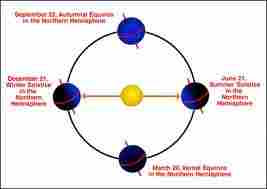
Q: Which position would be the northern hemisphere's winter?
A: The left position
This interactive site is great but currently not available.
The seasons are caused by the tilt of the earth which causes light to be more concentrated on different parts of the planet at different times of the year.

Q: Which position would be the northern hemisphere's winter?
A: The left position
This interactive site is great but currently not available.
Tuesday, March 8, 2011
Lunar Cycle Lesson
1. Click here to view the Brainpop lesson on the moon.
2. Click here to do an interactive lunar cycle activity.
3. Click here to take the lunar cycle challenge.
2. Click here to do an interactive lunar cycle activity.
3. Click here to take the lunar cycle challenge.
Sunday, February 13, 2011
DDT and Ecosystems
 Rachel Louise Carson (May 27, 1907 – April 14, 1964) was an American marine biologist and nature writer whose writings are credited with advancing the global environmental movement.
In the late 1950s, Carson turned her attention to conservation and the environmental problems caused by synthetic pesticides. The result was Silent Spring (1962), which brought environmental concerns to an unprecedented portion of the American public. Silent Spring spurred a reversal in national pesticide policy—leading to a nationwide ban on DDT and other pesticides—and the grassroots environmental movement the book inspired led to the creation of the Environmental Protection Agency. Carson was posthumously awarded the Presidential Medal of Freedom by Jimmy Carter.
http://en.wikipedia.org/wiki/Rachel_Carson
 Paul Hermann Müller(January 12, 1899 – October 12, 1965) was a Swiss chemist and Nobel laureate. In 1948 he received the Nobel Prize in Physiology or Medicine for his 1939 discovery of insecticidal qualities and use of DDT in the control of vector diseases such as malaria and yellow fever.
http://en.wikipedia.org/wiki/Paul_Hermann_Muller


Tuesday, February 8, 2011
Ocean Action Team Project
These links will be helpful when researching your topics:
RUNOFF (pollution):
Link 1
Link 2
Link 3
Link 4
Link 5 -Click on the strategies part to access areas w/ runoff
OVER HARVESTING (fishing):
Link 1
Link 2
Link 3
Link 4
Link 5
CORAL REEF DESTRUCTION & ARTIFICIAL REEFS:
Link 1
Link 2
Link 3
Link 4
Link 5
Link 6
Link 7
After your research is completed please click here to use your userID / password that your teacher assigned to begin creating your campaign.
RUNOFF (pollution):
Link 1
Link 2
Link 3
Link 4
Link 5 -Click on the strategies part to access areas w/ runoff
OVER HARVESTING (fishing):
Link 1
Link 2
Link 3
Link 4
Link 5
CORAL REEF DESTRUCTION & ARTIFICIAL REEFS:
Link 1
Link 2
Link 3
Link 4
Link 5
Link 6
Link 7
After your research is completed please click here to use your userID / password that your teacher assigned to begin creating your campaign.
Thursday, January 27, 2011
Wednesday, January 19, 2011
Topographic Map Quiz
Put your name on the top of your paper.
Number your paper from 1 to 13.
For a quick review over some cool topo maps click HERE.
Click HERE to find 13 pictures for you to match to the correct topographic map. Put the letter next to the correct number.
Number your paper from 1 to 13.
For a quick review over some cool topo maps click HERE.
Click HERE to find 13 pictures for you to match to the correct topographic map. Put the letter next to the correct number.
Monday, November 29, 2010
PLATE TECTONICS UNIT RESOURCES
LAYER C1 - helpful links:
* Click below to read & see pictures about the CONTINENTAL DRIFT THEORY.
C1 - QUIZ
** After completing the c1 layer: Click on the link below to take a short quiz.
PLEASE WRITE YOUR ANSWERS ON A PIECE OF PAPER & take it to your teacher so she can check your yellow sheet.
C1 QUIZ
LAYER CII - USEFUL LINKS
CII-f: Click HERE for instructions for Mountain Movers lab.
or Click HERE to go straight to the Mountain Movers Lab
Geology Dictionary
or look for the vocabulary link at the top of the blog for lots more dictionary sites.
C2 - QUIZ
** After completing the c2 layer: Click on the link below to take a short quiz.
PLEASE WRITE YOUR ANSWERS ON A PIECE OF PAPER & take it to your teacher so she can check your yellow sheet.
CII QUIZ
LAYER B - USEFUL LINKS:
B Layer - QUIZ
** After completing the B layer: Click on the link below to take a short quiz.
PLEASE WRITE YOUR ANSWERS ON A PIECE OF PAPER & take it to your teacher so she can check your yellow sheet.
B LAYER QUIZ
LAYER A - USEFUL LINKS:
B-a: Google Earth Tour: Click HERE for a video tutorial on how to create a Google Tour using Google Earth.
Requirements: Find 10 landforms on the earth that were created at plate boundaries.
Review Materials:
Vocabulary Review - Do you know all the words?
* Click below to read & see pictures about the CONTINENTAL DRIFT THEORY.
- WEBSITE 1 - lots of good info about evidence for Continental Drift Theory.
- WEBSITE 2 - more of the above plus info about layers of the earth.
- WEBSITE 3 - A great animation & lesson on the break up of Pangaea.
- WEBSITE 4 - A wonderful lesson about Continental Drift Theory.
- WEBSITE 5 - An animation that shows how the plates might move in the future.
C1 - QUIZ
** After completing the c1 layer: Click on the link below to take a short quiz.
PLEASE WRITE YOUR ANSWERS ON A PIECE OF PAPER & take it to your teacher so she can check your yellow sheet.
C1 QUIZ
LAYER CII - USEFUL LINKS
CII-f: Click HERE for instructions for Mountain Movers lab.
or Click HERE to go straight to the Mountain Movers Lab
Geology Dictionary
or look for the vocabulary link at the top of the blog for lots more dictionary sites.
C2 - QUIZ
** After completing the c2 layer: Click on the link below to take a short quiz.
PLEASE WRITE YOUR ANSWERS ON A PIECE OF PAPER & take it to your teacher so she can check your yellow sheet.
CII QUIZ
LAYER B - USEFUL LINKS:
B Layer - QUIZ
** After completing the B layer: Click on the link below to take a short quiz.
PLEASE WRITE YOUR ANSWERS ON A PIECE OF PAPER & take it to your teacher so she can check your yellow sheet.
B LAYER QUIZ
LAYER A - USEFUL LINKS:
B-a: Google Earth Tour: Click HERE for a video tutorial on how to create a Google Tour using Google Earth.
Requirements: Find 10 landforms on the earth that were created at plate boundaries.
- a computer with Google Earth downloaded.
- internet connection
- a video player for the tutorial
- a way to save the .kmz tour file & either email it or bring it to me from home on flash drive.
Review Materials:
- Click HERE to make sure you understand the plate tectonics theory.
- Click HERE for an interactive lesson on plate tectonics theory.
- Click HERE for another great interactive lesson on plate tectonics.
Vocabulary Review - Do you know all the words?
- Click HERE for review games / flashcards.
- Click HERE for more vocabulary review games.
- Click HERE for more flashcards.
Subscribe to:
Posts (Atom)